ALPS: A Kimley-Horn Software Solution
Kimley-Horn’s Advanced Land Transportation Performance Simulation™ (ALPS™) software provides unsurpassed precision in evaluating airport terminals, curbfronts, and landside environments.
The future we’re facing is uncertain and unsettling for many airports. In this time of ambiguity, it’s essential to strategize and adapt. Effective airport scenario planning can help you prepare for success whether what’s to come includes a return to pre-COVID-19 airport activity, changes in the way airlines serve communities, or other unforeseen circumstances.
Airports should define the future in broad terms and have a plan in place to adapt their organization, operations, and facilities for multiple potential scenarios.
Much of the data airports need to make informed decisions is readily available. Ask yourself:
The FAA believes there is an organic shift to safety and standards projects occurring now that capacity projects are difficult to justify. Projects that address these issues will receive higher priority for FAA funding. With this in mind, consider:
Next, consider the condition of your non-airfield assets. Now is a great time to determine the lifespan of your systems and put together a plan that identifies priorities for replacement or maintenance. Since asset management represents a large portion of the investments required to maintain your facilities, it’s an important component of any comprehensive airport scenario plan.
Lastly, consider if your airport has underutilized land that could drive revenue. If there is land not needed in the long-term to support aeronautical functions, there are opportunities to develop it for revenue generation that is not dependent on aviation traffic. Examples include industrial and logistics facilities. Section 163 of the FAA Reauthorization Act of 2018 limits the FAA’s control over airport land, giving airports more land use control.
The FAA has temporary guidelines related to the challenges posed by using traditional forecasting techniques in a time of uncertainty. Obtaining FAA approval for forecasts will be difficult until clear patterns of aviation activity emerge, which could take several years. As a result, an efficient airport scenario plan should be developed through a facilitated discussion about possible future events.
With a broad set of stakeholders, consider changes that may impact airline plans, aircraft fleets, passenger behavior, and other factors. For example, with passenger demand, we anticipate different patterns of increasing activity for leisure travelers as compared to business travelers. The timing of a “return to 2019 levels” will vary based on the type of traveler, the specific airport, and how it fits into the airline system.
Additional aspects that may influence planning include social distancing and its influence on space planning in the passenger terminal environment. While best practices related to the pandemic continue to evolve and a COVID-19 vaccine is still in the works, airports will want to examine how they can make changes now in preparation for future pandemics or other unforeseen circumstances that could impact their business.
Once you have identified the various future scenarios, the next step is to develop an independent plan to prepare for each. The plan should clearly prioritize what is important to the organization, including its financial and operational health. It may include facility needs, operational changes, and staffing changes. On the revenue side, some scenarios may necessitate enhanced non-aviation revenue development to allow the organization to prosper and continue to invest.
Instead of using milestone years to indicate when investments in facilities or other items are needed, airport owners should identify Planning Activity Levels (PALs) that indicate when investment is warranted—an approach the FAA supports.
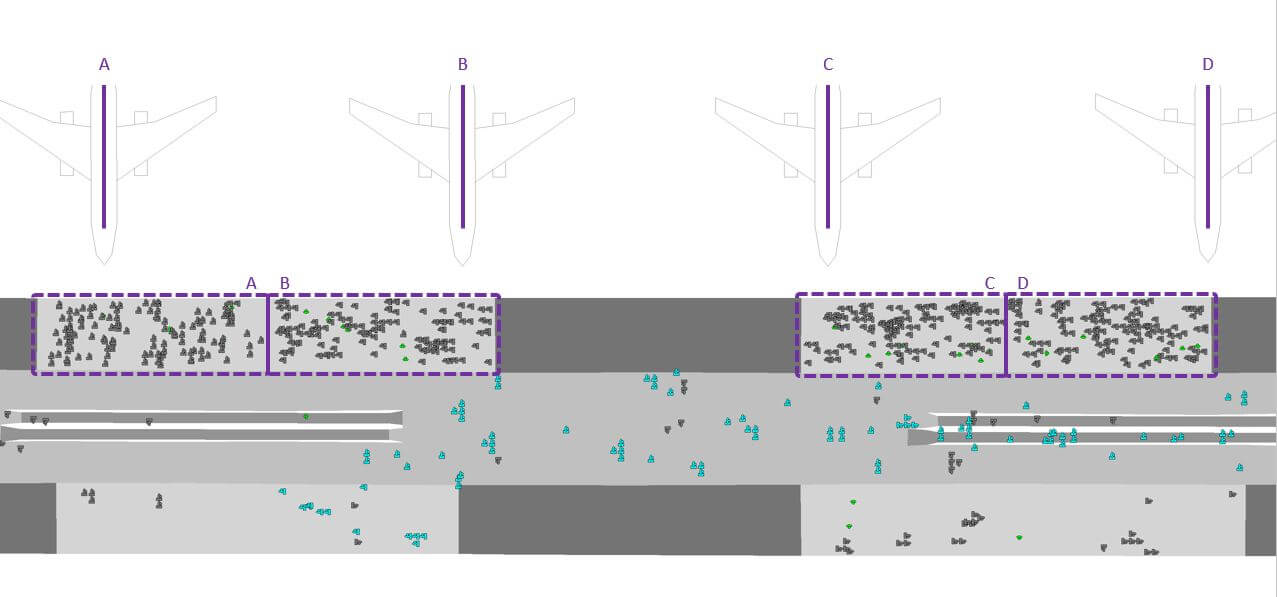
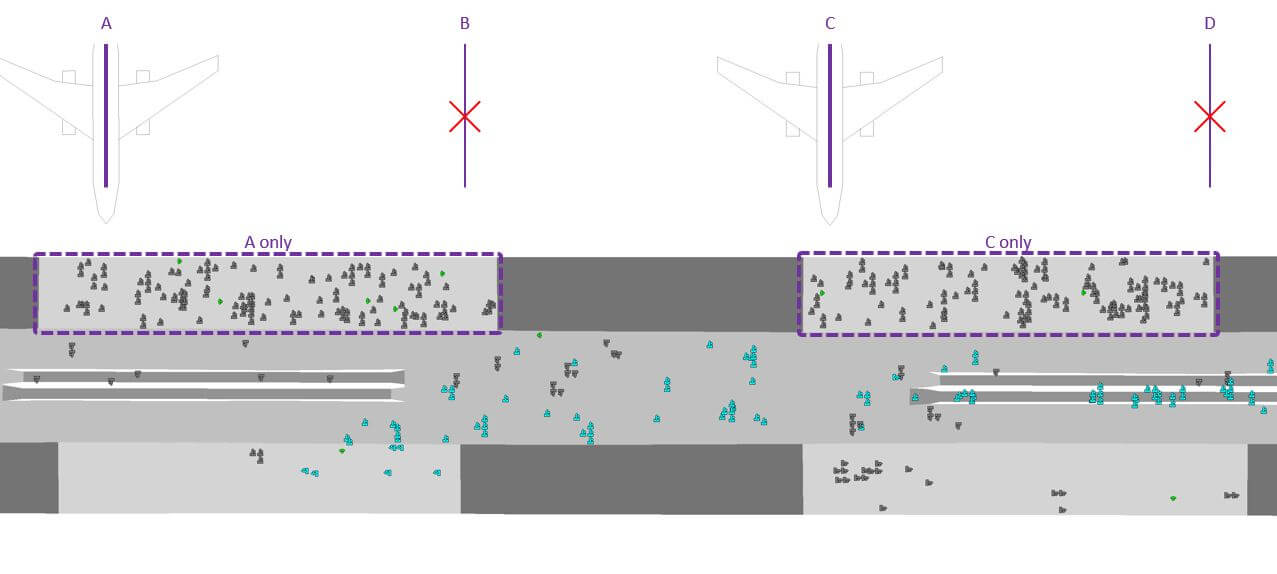
Kimley-Horn uses its own simulation model called ALPS (Advanced Land Transportation Performance Simulation) to help clients evaluate potential future scenarios. The simulations below show two gate scenarios that could be used to help airports make decisions about how to support social distancing at the gate areas.
Example A: All 4 Gates Open / Holdrooms Active (average density of 18 SF/person)
Example B: Every Other Gate Open to Support Social Distancing (average density of 36 SF/person)
Finding commonalities can help you:
Once the various airport scenario plans have been developed, look for common elements. For example, the security screening function and the passenger processing elements of the plans may have strong similarities as shared infrastructure is often required over a range of demand levels.
A strong plan also identifies ways that a facility can adapt to changing needs. Consider incorporating “programmable space,” which provides the ability to reconfigure building interiors to adapt to changes in passenger flow and needs. Using flex space, you can change the terminal interior to accommodate concessions space, holdroom space, family gathering areas, business traveler areas, and other zones with currently undefined functions (such as health screening/testing spaces).
Flexibility is key in developing a plan. Ensure your plan can respond to emerging trends. Your future scenarios should focus on features that allow you to easily pivot to meet demands. Plans should also monitor demand trends, allowing you to make informed decisions about the best path forward.
For example, recently, we’ve seen massive numbers of older airplanes being retired as airlines redefine themselves in the market to meet new passenger demand levels. Airport sponsors should plan for facilities that can accommodate aircraft with different wingspans and fuselage lengths. This is just one factor airports should consider when making decisions about how and when to invest.
Predictability is hard to come by right now. Having a dynamic and strategic airport scenario plan that anticipates the future can provide peace of mind. Start planning now so you can confidently say you’re prepared for whatever the future holds.
Kimley-Horn’s Advanced Land Transportation Performance Simulation™ (ALPS™) software provides unsurpassed precision in evaluating airport terminals, curbfronts, and landside environments.