Streamlining Vehicle Miles Traveled Mitigation for the City of Riverside
Challenge
Solution
Impact
Project Recognition
Challenge
Rather than aligning with the level of service (LOS) traffic metrics used in other US states, California requires the use of Vehicle Miles Traveled (VMT) for determining transportation environmental impacts, which can pose a challenge for developers.
As part of the California Environmental Quality Act (CEQA), VMT measures the total trip distance that vehicles travel rather than LOS, which evaluates delay at intersections or along roadway segments. This shift was intended to encourage shorter trips, promote infill development, and reduce vehicle emissions, but it has added complexity for developers navigating environmental approvals.
Developments that generate VMT beyond the established threshold must mitigate or reduce it; for instance, by implementing programs to encourage carpooling, biking, or transit usage. However, depending on the land use type (residential, commercial, industrial, etc.) and project location, fully mitigating a VMT impact can be extremely challenging and costly.
In light of this challenge, the Kimley-Horn team developed a solution in partnership with the City of Riverside to enhance their VMT evaluation and mitigation processes.
Solution
Many VMT mitigation solutions require ongoing monitoring or can be challenging to implement, but the Kimley-Horn team leveraged our automated VMT calculations platform for streamlined results.
By developing a VMT mitigation bank, Kimley-Horn and the City of Riverside created a solution that only requires developers to pay a one-time fee while also providing funding to the City’s active transportation infrastructure projects. Furthermore, by integrating trip generation and trip distance data from Riverside County’s travel demand model into Kimley-Horn’s cloud-based TREDLite VMT application, the City of Riverside provided developers with a tool to efficiently calculate their project’s VMT efficiency, mitigation need, and total mitigation cost. The developers can then print a report from TREDLite and submit it to the City, pay their VMT mitigation fees, and move forward with development, significantly shortening the approval process.
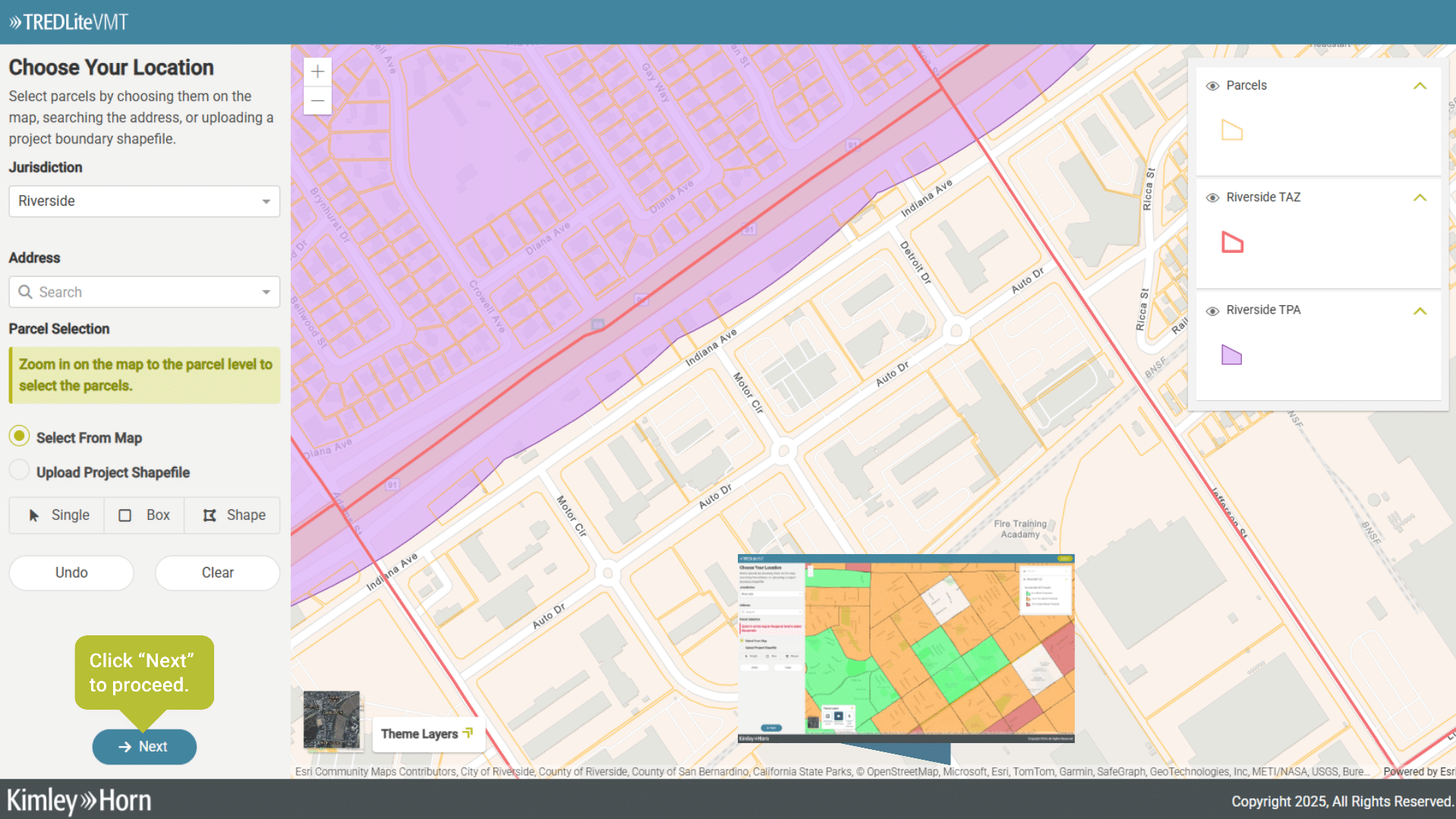
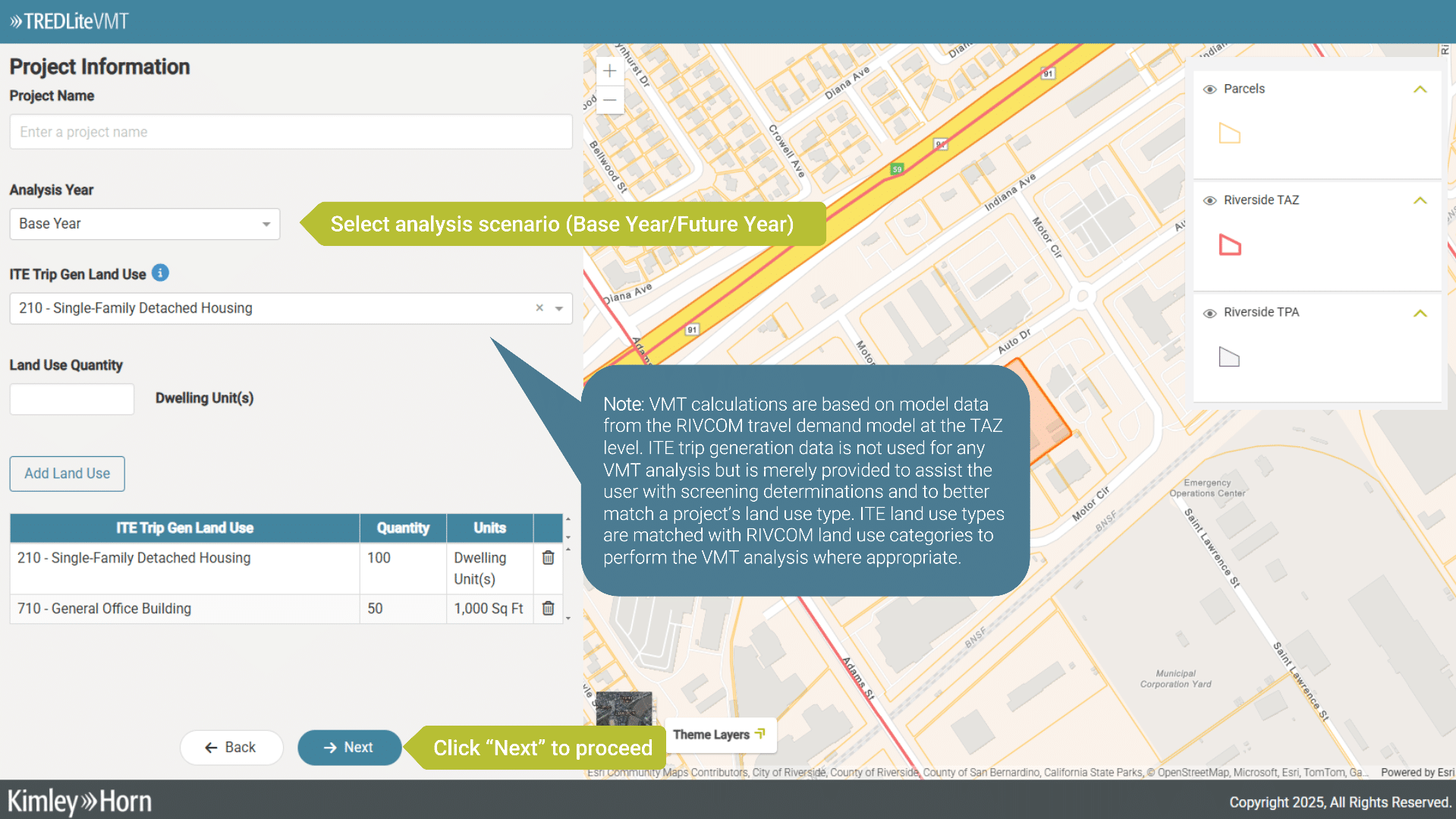
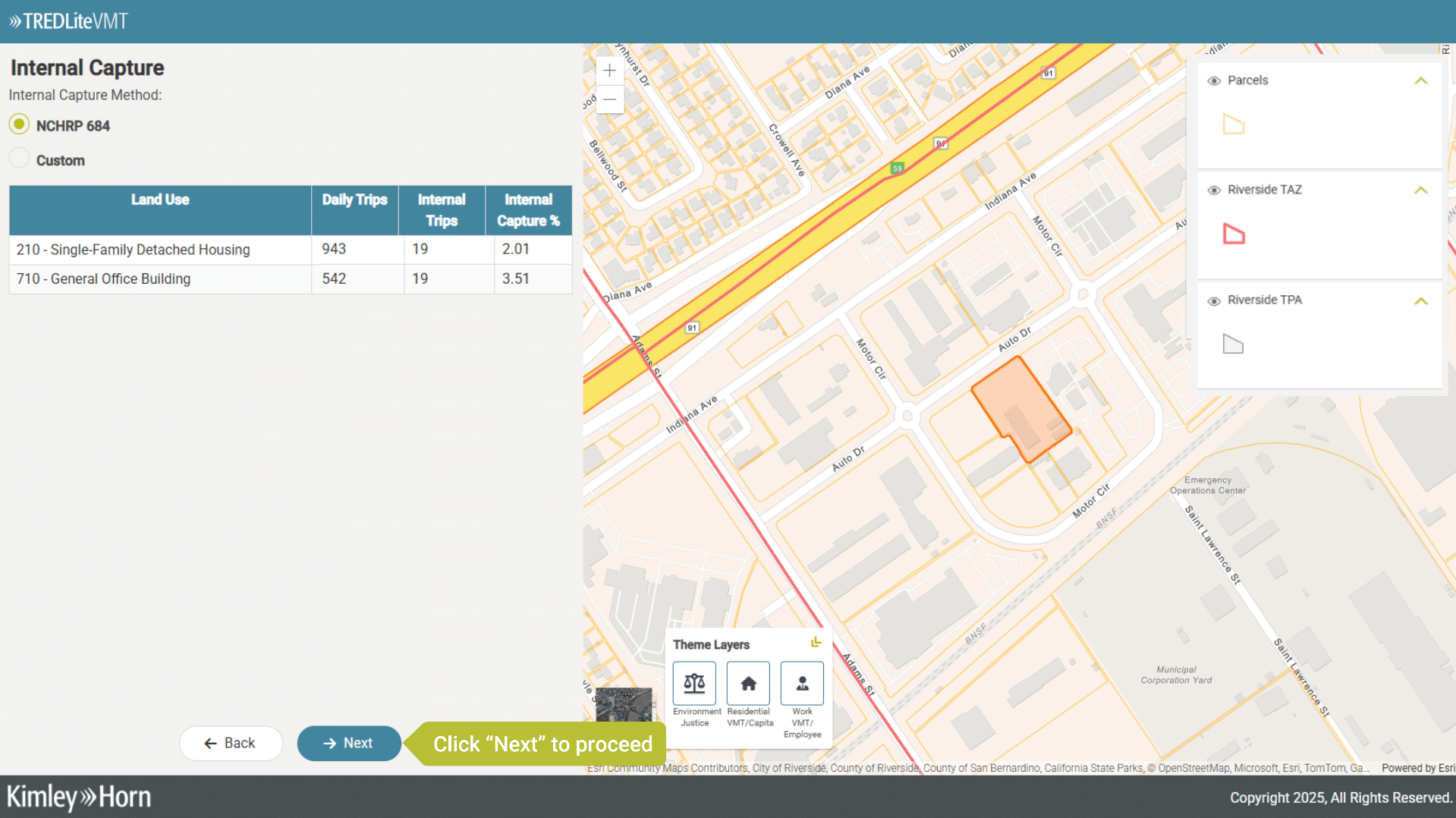
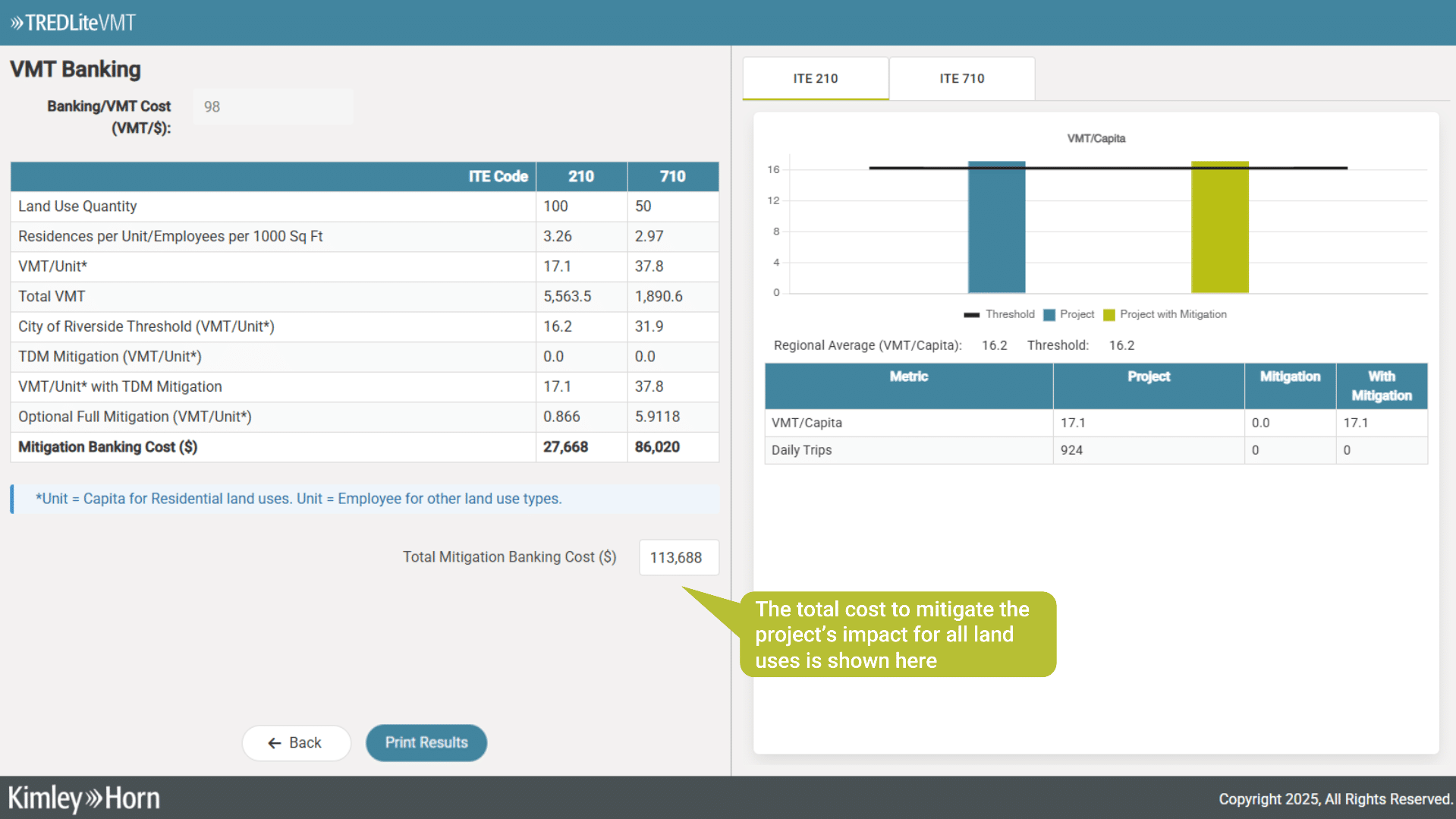
Examples of TREDLite VMT Interface and Outputs
To help ensure input was received from the widest range of stakeholders possible, the City of Riverside and Kimley-Horn conducted outreach and gathered feedback from groups like the University of California, Riverside; transit operators; healthcare professionals; community-based organizations; developers; and the general public. The team also focused on input from bicycle advocates since the program prioritizes funding for bike and pedestrian projects throughout Riverside. Additionally, a project website was set up to provide project updates, background information, and links to TREDLite and other City documents, such as their transportation analysis guidelines.
Impact
The City of Riverside has continued to use TREDLite for VMT calculations on a variety of projects, and it has become the City’s de facto dashboard for development-related transportation analysis.
The VMT Mitigation Pilot Program is removing a significant challenge for developers and helping facilitate new developments, particularly residential projects, during an era of housing availability challenges in California. It is also creating a new funding source for the jurisdiction to fund community-focused priority projects that are not vehicle-centric.
Currently, the City of Riverside has produced a $98 per VMT mitigation rate fee—the lowest in the state—and has provided funding to back more than 15 bicycle enhancement projects, such as protected bike lanes that set a standard for safe, multimodal travel. Ultimately, the Kimley-Horn team has supported staff, the public, and elected officials to conceptualize and drive their own city-wide VMT processes. This enhanced VMT calculation and mitigation process is moving them step-by-step towards their vision for a vibrant city offering quality housing and a range of multimodal travel opportunities.
Related Projects & Case Studies