Florida’s Turnpike: Laying the Groundwork for Safer, Faster Travel

Enhanced Safety and Connectivity
Projected to safely accommodate travel demands, improve travel time and reliability, and enhance regional connectivity and emergency resiliency on Florida’s Turnpike following our services for the PD&E study

Extensive Public Involvement
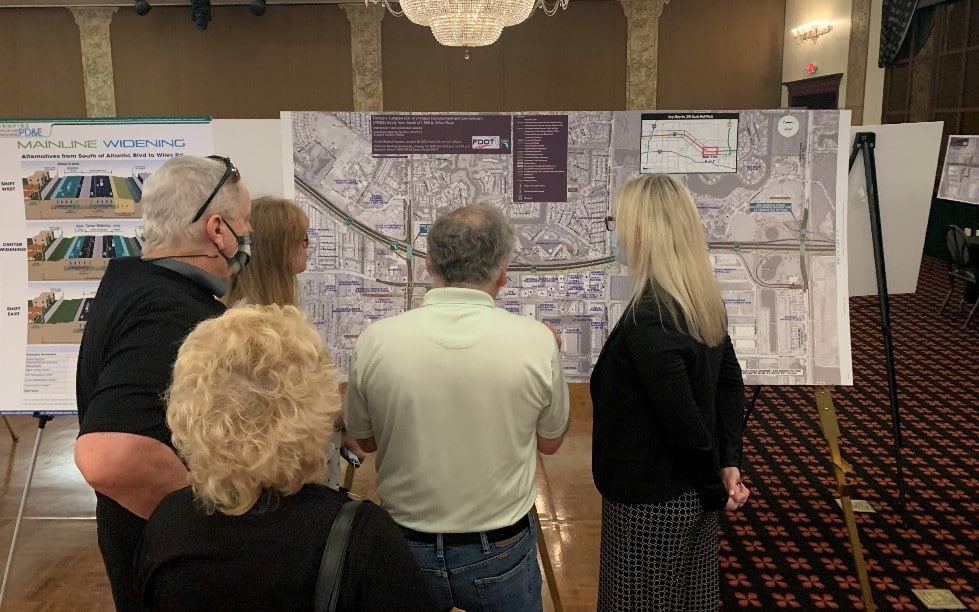
Collaborated with local Homeowners Associations, elected officials, the Broward Metropolitan Planning Organization, and other impacted communities and stakeholders to understand their needs and adjust the design accordingly

Unique Project Challenges
Navigated engineering and environmental challenges, including the need for a noise study, working within a limited existing right-of-way, and coordinating with Florida Gas Transmission due to constraints caused by the gas mains
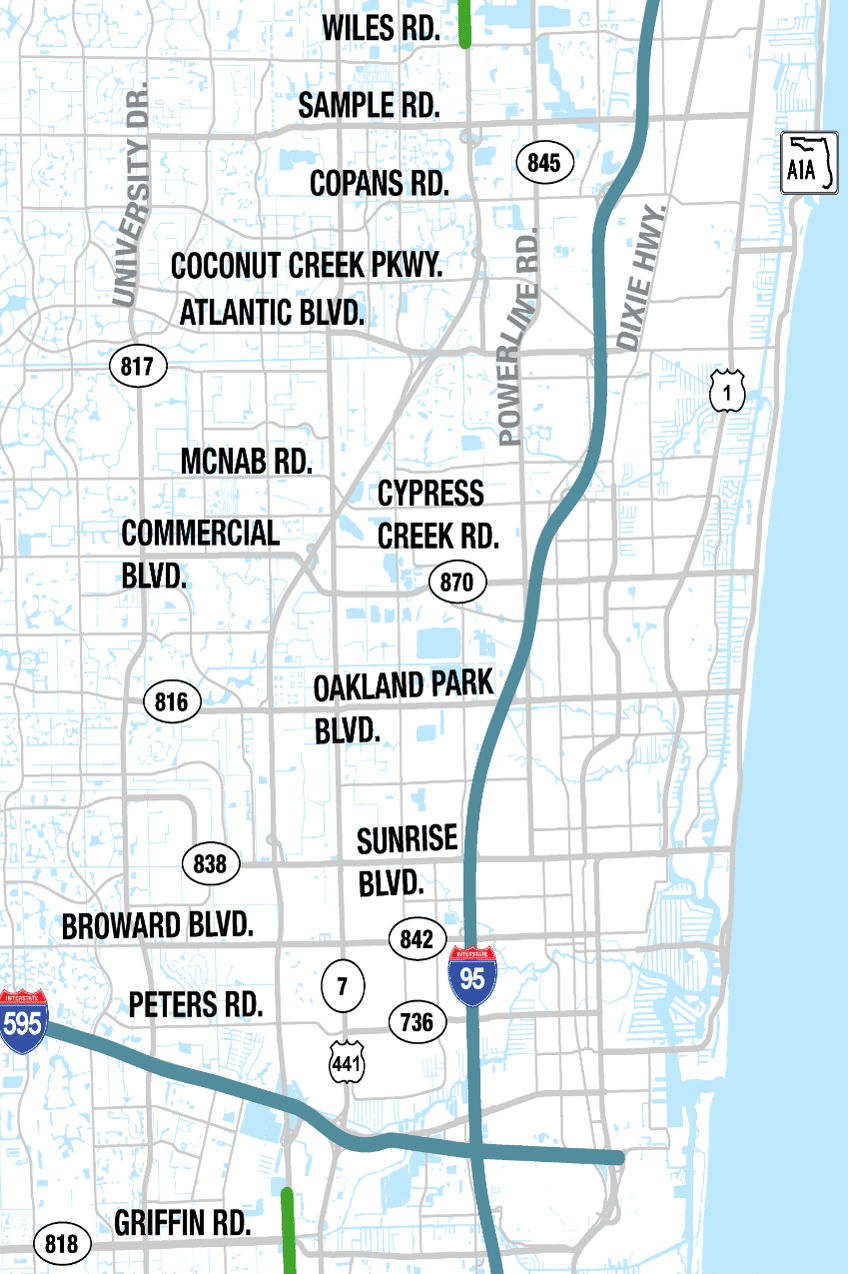
The current congestion on Florida’s Turnpike, along with the growing population of South Florida, has necessitated improvements to offer a safer and more efficient experience for the traveling public. As such, Kimley-Horn conducted a Project Development & Environment (PD&E) study to evaluate the widening of a 17-mile segment of Florida’s Turnpike from south of Interstate 595 (I-595) to Wiles Road.
The Turnpike currently offers eight lanes (four lanes in each direction) from I-595 to Atlantic Boulevard and six lanes (three lanes in each direction) from Atlantic Boulevard to Wiles Road. The PD&E process—a comprehensive study that evaluates social, economic, and environmental effects associated with proposed transportation improvements—enables the Florida Department of Transportation (FDOT) and Florida’s Turnpike Enterprise to determine the most suitable type, location, and conceptual design to meet the project’s purpose and need.
Offering Services for PD&E and Beyond
Completed in three parts, we led the PD&E study to evaluate 17 miles of roadway through 13 municipalities within Broward County, assess six existing interchanges, and design two new interchanges. Drawing on our team’s extensive experience in the area, we provided innovative solutions, such as supplying a separate direct connection to and from the Turnpike. We also introduced a grade-separated, displaced left-turn lane to reduce signal phases from four to two—thereby reducing queuing on the Turnpike. These approaches minimized the need for larger intersections and additional right-of-way, ultimately improving the flow of arterial traffic.
We provided the following services for this project:
- Conducted a public hearing for the PD&E study
- Designed solutions to widen the Turnpike to five lanes in each direction with auxiliary lanes
- Designed modifications to a portion of the service road and access to Pompano Beach Service Plaza to accommodate Florida’s Turnpike widening
- Evaluated improvements to the existing interchanges in the corridor as well as alternatives for new interchange locations
- Conducted an environmental analysis, including an evaluation of state protected species
- Coordinated with stakeholders, including Florida Gas Transmission, Broward Metropolitan Planning Organization, public officials, Homeowners Associations, and nearby communities
Additionally, to address the noise concerns of a community of elderly residents at Coconut Creek Parkway, we moved the southbound off-ramp and shifted the mainline eastward to maximize distance from the community.
Meeting the Transportation Needs of South Florida
Our team completed the PD&E study in 2024, and the design work for Florida’s Turnpike improvements will be divided into eight separate projects. After construction, the enhanced Turnpike will have five lanes in each direction, six modified interchanges, and two new interchanges, equipping the region for anticipated traffic growth through 2045 and beyond. Ultimately, the improvements will help enhance the traveling public’s safety and improve travel time reliability, thereby strengthening connectivity, emergency response preparedness, and economic vitality across the South Florida region.
Related Projects & Case Studies