Colorado Aviation Economic Impact Study (CEIS): Measuring Economic Growth through Data

Economic Analysis

Stakeholder Engagement

Data-driven Approach
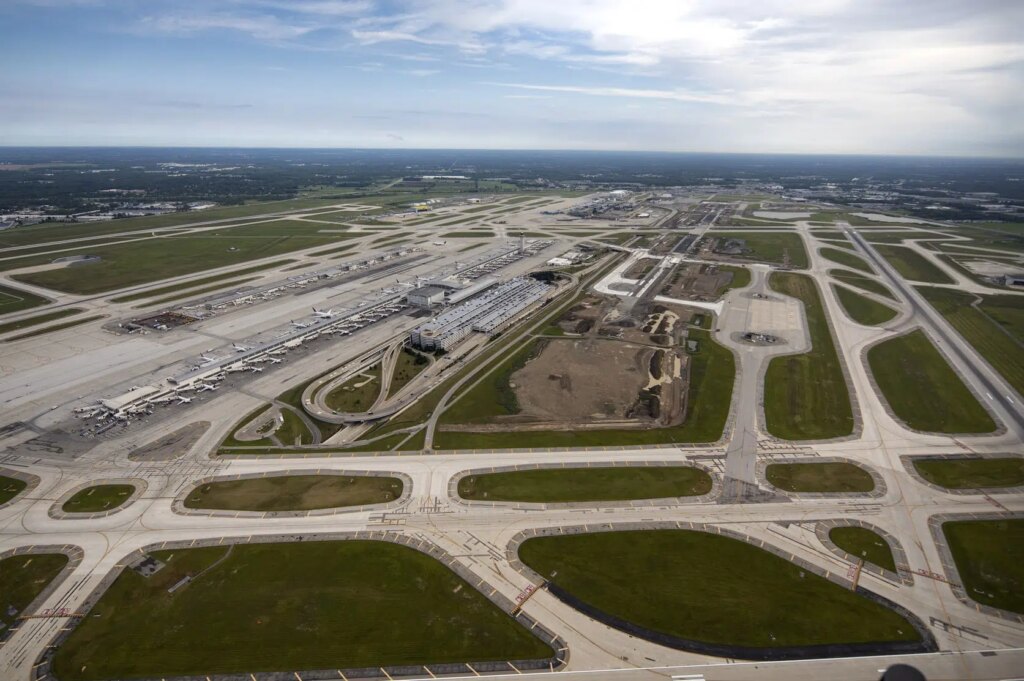
The Colorado Department of Transportation’s (CDOT) Division of Aeronautics engaged Kimley-Horn to deliver a comprehensive update to its previous Colorado Aviation Economic Impact Study (CEIS), which was also developed in partnership with Kimley-Horn. This new effort focused on capturing the most up-to-date data reflecting the ongoing growth in Colorado’s booming aviation industry, especially at major airports like Denver International Airport (DEN) and Colorado Springs Airport. Playing a vital role in the state’s transportation network and employment market, Colorado’s airport operations (alongside visitor spending) make a substantial contribution to the state’s economy.
Our team undertook an extensive data collection and analysis process, which resulted in a compelling suite of deliverables—including a statewide executive summary, technical reports, animated flight maps, and tailored airport reports—that highlight the vital role airports play across Colorado.
Project Recognition
• Featured in Colorado Governor Jared Polis’ press release: Colorado Airports Contribute $68.9 Billion Annually to State’s Economy


Our team completed a system plan and economic impact study, with the initial contract starting in 2018 and finishing in 2020, followed by a new contract in late 2023 that concluded in July 2025. We coordinated with 65 airports, ranging from DEN to small rural airports, and conducted on-site and virtual meetings collecting data on airport administration, jobs, payroll, capital expenditures, business tenants, and visitor spending.
This included extensive passenger intercept surveying at both commercial and general aviation airports, with data collection processes spanning several months of 2025. At most airports, our staff spent approximately four hours on-site, meeting with airport personnel, surveying business tenants, and taking photos to use in deliverables. Given the size and significance of DEN in Colorado’s economy, our team devoted additional time there to fully capture its nuances. We conducted several days of in-person passenger surveying, with team members assigned to different concourses to capture a variety of data, such as spending profiles for both domestic and international travelers.
Our team also strategically scheduled fieldwork to capture peak ski and snowboard travel season, a major component of visitor spending, and conducted a second round of surveys during summer to account for seasonal variations. Using IMPLAN, an economic impact analysis software that utilizes data from federal sources to calculate economic impact, we modeled the collected data to generate economic impacts at airport, regional, and statewide levels. This data covered the direct, indirect, and induced impacts, which included an off-airport air cargo analysis as well as aerospace industry impacts.
Data-Driven Deliverables and Key Findings
Once our services were complete, our suite of deliverables for both CDOT’s Division of Aeronautics and the 65 airports included:
- A technical report
- Statewide executive summary brochure
- Individual airport brochures
- PowerPoint presentations with speaker notes for each airport
- A statewide fact sheet for legislative and governor’s office use
- An updated project website outlining new deliverables
By providing individualized deliverables, each airport was able to share the study’s findings more clearly and effectively with their local government and other stakeholders.
The results of the CEIS showed more than 40% overall growth and significant shifts in airport activities and economic conditions compared to the previous study in 2020. Spanning airport administration, business tenants, construction, air cargo, and out-of-state visitor spending, Colorado’s aviation system now supports more than 348,000 jobs and $23.5 billion in payroll, adds $40.3 billion in value, and generates $68.9 billion in business revenue. This demonstrates that Colorado’s airports are not just gateways for travel—they are dynamic economic engines fueling the state’s growth and prosperity.
Related Projects