Traffic Sign Inventory and Condition Assessments Get Smarter With Artificial Intelligence

Kimley-Horn supports many roadway agencies across the U.S. through transportation asset management consulting services, helping them maintain and improve their infrastructure networks. This process typically involves asset inventory, condition evaluation, performance prediction, treatment selection, prioritization, and optimization of budget allocation. Through this data-driven process, Kimley-Horn’s traffic engineers provide decision-makers with short- and long-term maintenance and capital improvement plans.
Condition assessments and asset inventory are now being taken to a new level of efficiency using artificial intelligence (AI). Using iENGINEERING’s transportation engineering software, Transconomy, Kimley-Horn created a traffic sign inventory and condition database for the City of Lone Tree, Colorado.
Selecting a System: Using AI for Rapid Image Processing
Transconomy automates and accelerates data processing activities, automatically detecting and classifying:
- Traffic signs in accordance with the Federal Highway Administration’s Manual for Uniform Traffic Control Devices (MUTCD);
- Point assets such as light posts, utility poles, and fire hydrants;
- Line assets such as guardrails, medians, and barriers; and
- Many other asset types.

Transconomy proved to be a beneficial software system for the City of Lone Tree when in addition to traditional automated collection methods for the City’s pavement inventory, Kimley-Horn was asked to collect imagery and perform condition assessments for over 4,000 traffic signs within the City’s boundary. The City was interested in establishing a baseline inventory of the signs, including initial condition assessments on a 1 to 4 scale, with associated and geotagged imagery for each sign.
Due to the project location’s proximity to an airport, the layout of adjacent neighborhoods, and COVID-19 concerns, imagery was not allowed to be collected via drones or LIDAR methods. Utilizing a robust machine learning software system and careful, yet rapid processing of thousands of images, we were able to provide the City with the basis for a sign inventory, allowing them to forecast annual budgeting for sign repairs and replacements.
Capturing, Analyzing, and Exporting Robust Image Data Sets
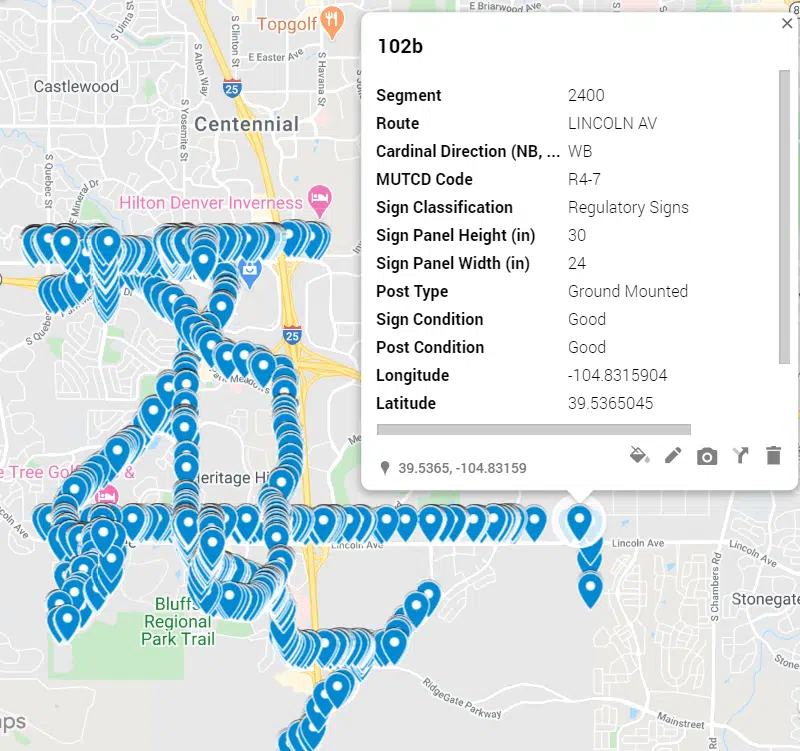
Kimley-Horn collected about 100 lane-miles of street imagery using a GoPro camera. Nearly 50,000 images were then uploaded to the cloud, where the Transconomy AI algorithm was executed. These raw images were automatically processed to identify assets, remove duplicate assets in consecutive images, and geotag asset locations on a map. The software provides the GIS-based asset inventory in SHP for use in Esri applications and KML files for use in Google applications.
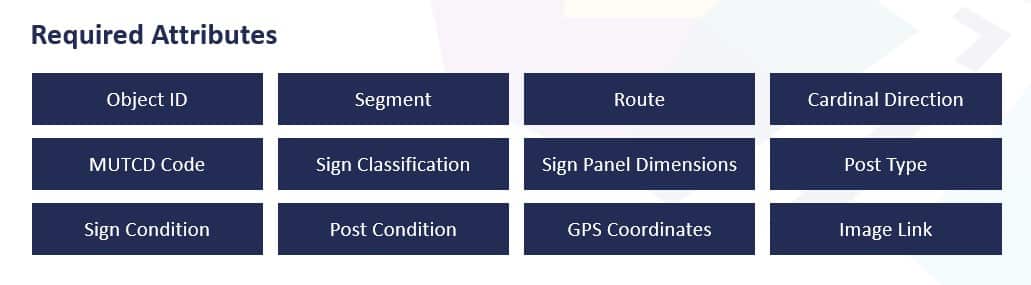
The team also used a semi-automated approach to determine the condition of sign faces and signposts for this project. In addition to the GIS files, all data were also delivered in a CSV file format to the City for full visibility and improved record keeping.
Automated condition assessments and asset inventory are safer and more efficient, using today’s available AI technology. To learn more about how our experts and technology can help with your asset management needs, contact Kathy Keegan, Tim Miller, or Scott Sounart or submit a service inquiry.



Related Insights