Preparing for a More Complex Housing Element Cycle
California jurisdictions are looking ahead to the 7th Cycle Housing Element Update, which will shape local housing policy, land use strategy, and implementation priorities for the next eight-year planning period.
Building on the sweeping changes introduced during the 6th Cycle and recent housing legislation, the 7th Cycle will bring continued scrutiny of site inventories, fair housing analyses, program feasibility, implementation progress, and ongoing compliance requirements. Jurisdictions that begin planning early will be better positioned to assess prior commitments, respond to evolving state requirements, and develop practical, locally grounded solutions that support both certification and long-term success.
Download our 7th Cycle Housing Guide to help you prepare.
What’s Changing in the 7th Cycle
The legislation that matters for the 7th Cycle falls into four areas. Each one changes a specific part of how a Housing Element gets built and certified.
1. Fair Housing and Special Needs
Affirmatively Furthering Fair Housing (AFFH), California Assembly Bill (AB) 686, was the single largest source of Department of Housing and Community Development (HCD) comments in the 6th Cycle, and scrutiny is intensifying. California Senate Bill (SB) 7 adds a new acutely low-income Regional Housing Needs Allocation (RHNA) category for households at or below 15 percent of the area median income, defined through AB 1043. The jurisdictions will need to plan for an AFFH analysis with specific, measurable actions and enable the building of the acutely low-income category.
2. Site Inventory and Zoning Requirements
By-right housing on commercial sites, further Accessory Dwelling Unit (ADU) reforms, and tighter realism standards for reused sites all change what an inventory can claim. Capacity assumptions now have to account for transit-proximate density, commercial conversions, and ADU production, with every site defensible under HCD’s realism review. Affected jurisdictions must also account for SB 79 implications, which set tiered height and density near qualifying transit and allow that added capacity to count toward RHNA.
3. CEQA and Processing
A statutory infill exemption under AB 130 and a companion exemption for Housing Element rezoning under SB 131 remove a major environmental review bottleneck. Streamlining through SB 35 and SB 423 narrows review to a single unmet criterion, and deadlines tighten approval timelines. Implementation programs can be sequenced around these exemptions, turning rezoning from a multi-year CEQA exercise into a much shorter path.
4. Enforcement, Compliance, and Penalties
Only HCD can find a jurisdiction in compliance, and the Builder’s Remedy was reformed rather than eliminated. Recent enforcement bills, including AB 1886 and AB 712, ended self-certification and expanded the remedies and monthly penalties for violating state housing law. The cost of a late or non-compliant element is higher than it has ever been, and the most reliable protection is timely HCD certification.
Act Now
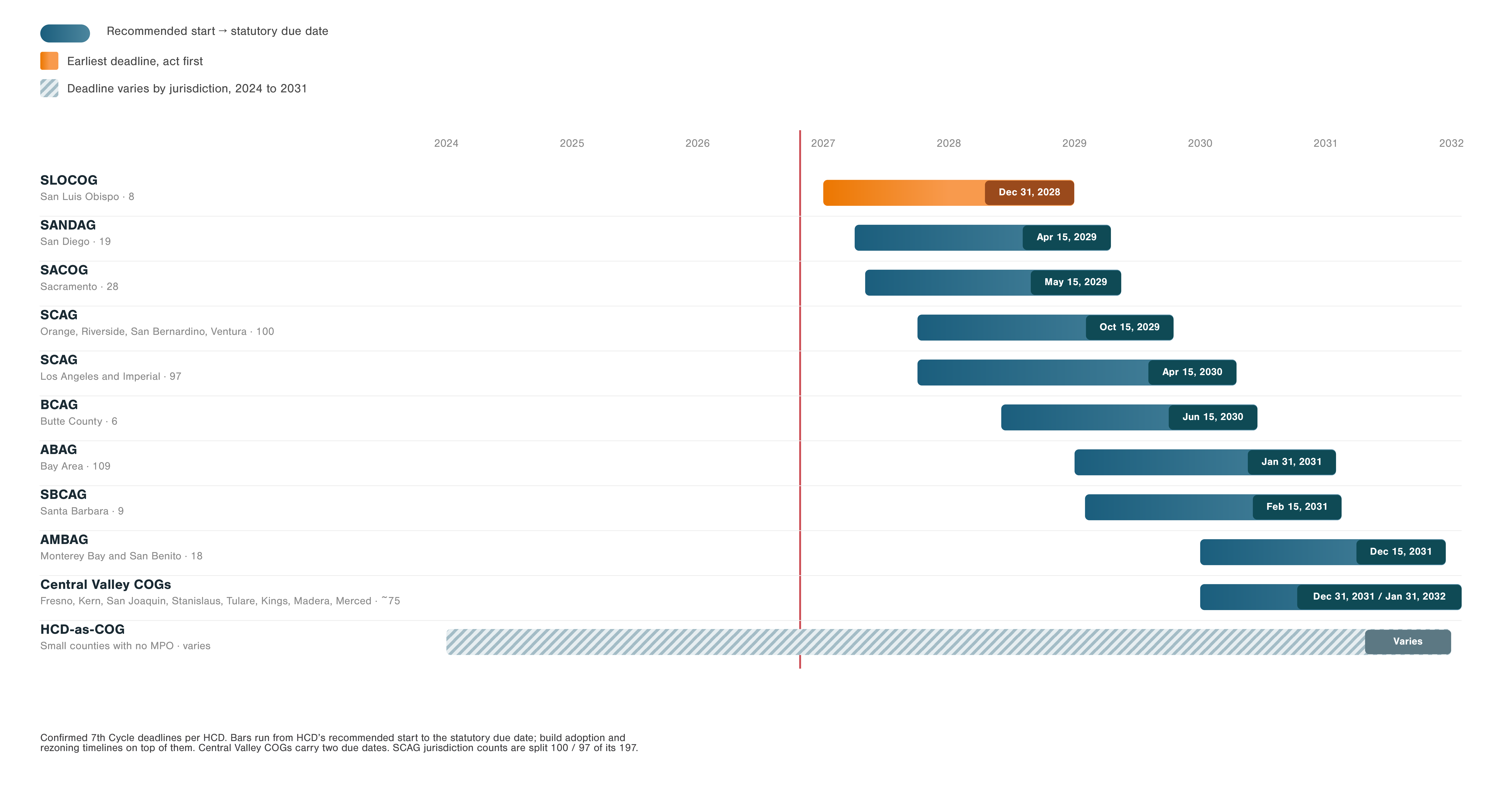
The most successful Housing Element updates begin well before a jurisdiction’s due date. Based on our experience assisting jurisdictions during the 6th Cycle, we recommend starting 20-24 months in advance to allow adequate time for technical analysis, community engagement, policy development, environmental review, and HCD review. Jurisdictions do not need to wait for RHNA allocations to begin many foundational tasks, including existing conditions analysis, constraints analysis, fair housing evaluation, community outreach, program assessment, and even potential site identification. Completing this work early streamlines the overall process, leaves room to adapt as requirements change, and avoids rushed, last-minute decisions.
Kimley-Horn’s Approach to 7th Cycle Housing Elements
Kimley-Horn’s Housing Element approach is grounded in collaboration, technical rigor, and implementation. We work closely with local agencies to develop housing strategies that are compliant, achievable, and tailored to each community’s unique needs. While certification is a critical milestone, we recognize that a successful Housing Element must also be implementable and effective throughout the entire planning period.
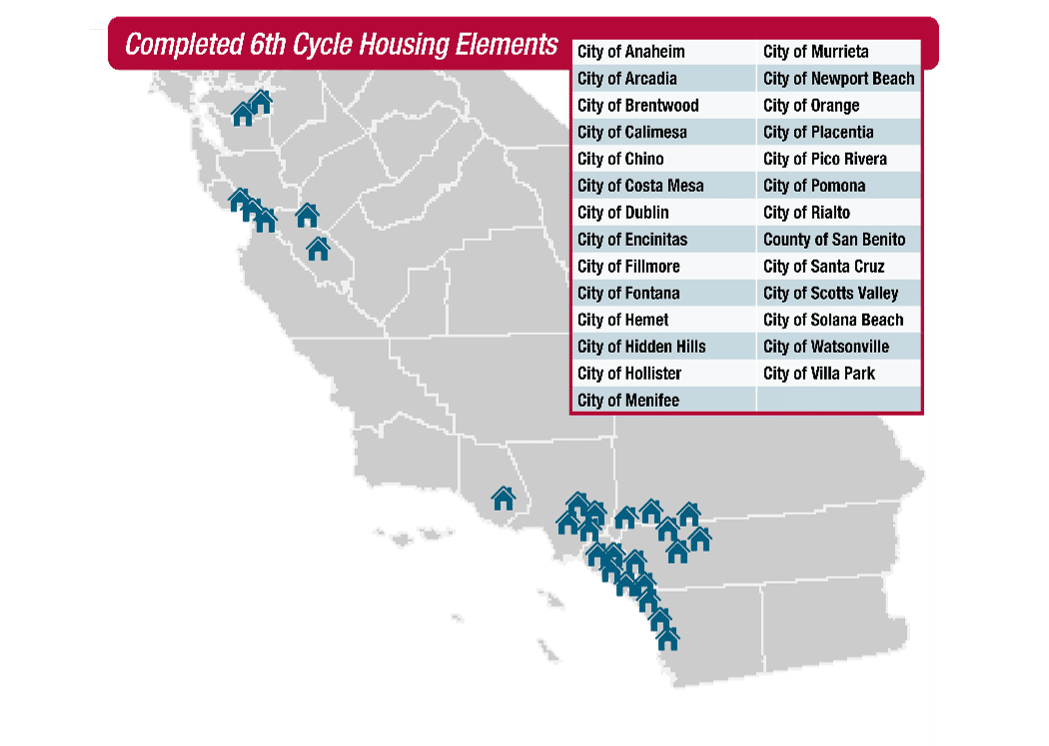
Having supported more than 30 Housing Element updates during the 6th Cycle, our team understands the issues most likely to result in HCD findings, adoption delays, and implementation challenges. Our work is completed by an integrated, in-house team of planners, GIS specialists, public engagement practitioners, policy analysts, and CEQA professionals. This allows us to streamline coordination, maintain consistency, and provide jurisdictions with a single-firm solution from Housing Element preparation through implementation.

 Plan: We begin by reviewing prior-cycle performance, local needs, and RHNA obligations. We then conduct a parcel-level, GIS-based evaluation of programs, land capacity, and site feasibility. This data-driven review helps ensure the Housing Element is grounded in realistic assumptions from the start.
 Align: A strong Housing Element does more than satisfy State requirements. We align the housing strategy with the General Plan, infrastructure capacity, mobility goals, economic development objectives, and concurrent planning efforts. This coordination helps ensure the Housing Element supports the community’s broader vision and can be practically implemented.
 Collaborate: We tailor engagement strategies to each community’s unique needs and preferred communication methods. Engagement may include in-person and virtual workshops, pop-up events, stakeholder meetings, online surveys, and interactive mapping tools. This outreach process provides well-documented input that informs the Housing Element, supports the AFFH analysis, and builds public support for adoption.
 Execute: We develop Housing Elements that are designed for implementation. Each program includes a responsible party, schedule, and funding strategy. We also support implementation through rezoning efforts, ordinance updates, and Annual Progress Reports.