Risk-Based Pavement Management for Airports: Looking Beyond Condition Ratings
What if your worst pavement isn’t your biggest risk?
For decades, airport pavement management has focused on answering a single question: What condition is the pavement in? Surface condition assessments and network-level ratings such as the Pavement Condition Index (PCI) have become the industry standard for evaluating pavement health and prioritizing maintenance investments.
But airports do not operate on pavement conditions. They operate on risk.
A pavement section in poor condition may continue performing for years with minimal operational impact, while a small, distressed area in a runway touchdown zone, critical taxiway intersection, or heavily trafficked wheel path may present a much greater consequence to safety, operations, and future cost.
Today’s airports face many challenges. Budgets are constrained, aircraft are larger, missions are more demanding, and downtime is increasingly expensive. The question should no longer simply be, “What condition is the pavement in?” The more relevant question is, “Which pavement presents the greatest operational risk, what is driving that risk, and what is the most effective response?”
What is risk-based pavement management?
Risk-based pavement management builds on traditional pavement management by integrating surface, structural, operational, and subsurface data to evaluate pavements as complete infrastructure systems.
Instead of viewing a runway as a single pavement section with an average condition rating, engineers evaluate:
- Comprehensive surface distress type, severity, and density
- Location-based structural condition and capacity
- Operational importance and traffic concentration
- Foreign object debris (FOD) risk
- Location-specific factors such as touchdown zones, intersections, wheel paths, and high-stress areas
- Subsurface conditions including stratigraphy, moisture, voids, and drainage issues
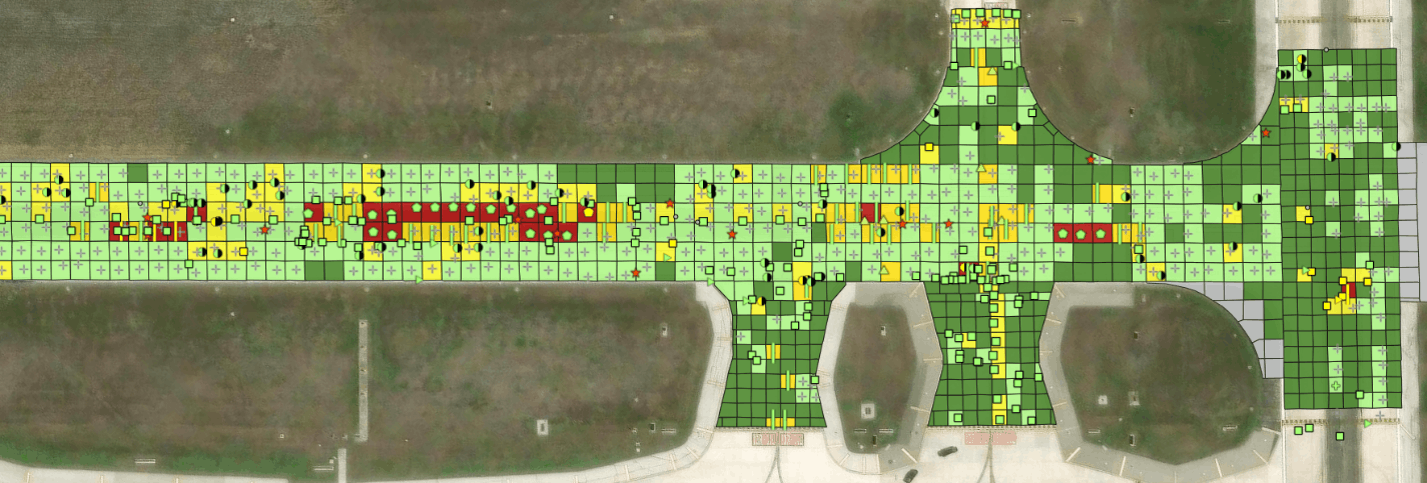
Example of distress survey visual results at an airfield
This approach aligns with modern pavement management practices that emphasize optimizing life-cycle cost, reducing uncertainty, and extending pavement life through targeted interventions.
Why does this matter?
It matters because not all pavement failures carry the same consequences.
A small area of deteriorated pavement in a runway touchdown zone may present significantly greater operational impact than a much larger distressed area on a lightly used apron. Likewise, two cracks that look identical on the surface may have completely different root causes below grade.
Traditional approaches often treat large pavement areas because uncertainty makes it difficult to confidently isolate the true problem. Risk-based pavement management reduces that uncertainty, and the result is a more precise approach to maintenance and rehabilitation.
What does a better pavement evaluation look like?
The future of pavement management is not just about seeing the surface better. It is about understanding what is happening on, within, and below the pavement structure.
Comprehensive geospatial distress mapping can identify every distress across an airfield rather than relying solely on sampled areas. When combined with structural evaluations, geotechnical investigations, geophysical surveys, and digital modeling, engineers gain a much clearer understanding of why deterioration is occurring and where future failures are most likely to develop.
At Kimley-Horn, we often describe this multi-dimensional approach as an “Airfield MRI.” Instead of isolated data points, owners gain a location-based understanding of pavement conditions, structural performance, drainage behavior, subsurface anomalies, and operational risk.
What kind of decision does this support?
It helps answer questions airports face every day:
- Which repairs are most critical to safety and operations?
- Where can maintenance extend pavement life most effectively?
- Which pavement sections require reconstruction and which do not?
- What are the consequences of delaying action?
- How can limited funding produce the greatest operational benefit?
At the Indianapolis International Airport, this approach supported targeted repair recommendations focused on the areas presenting the greatest operational risk, helping prioritize maintenance dollars where they produced the greatest operational benefit.
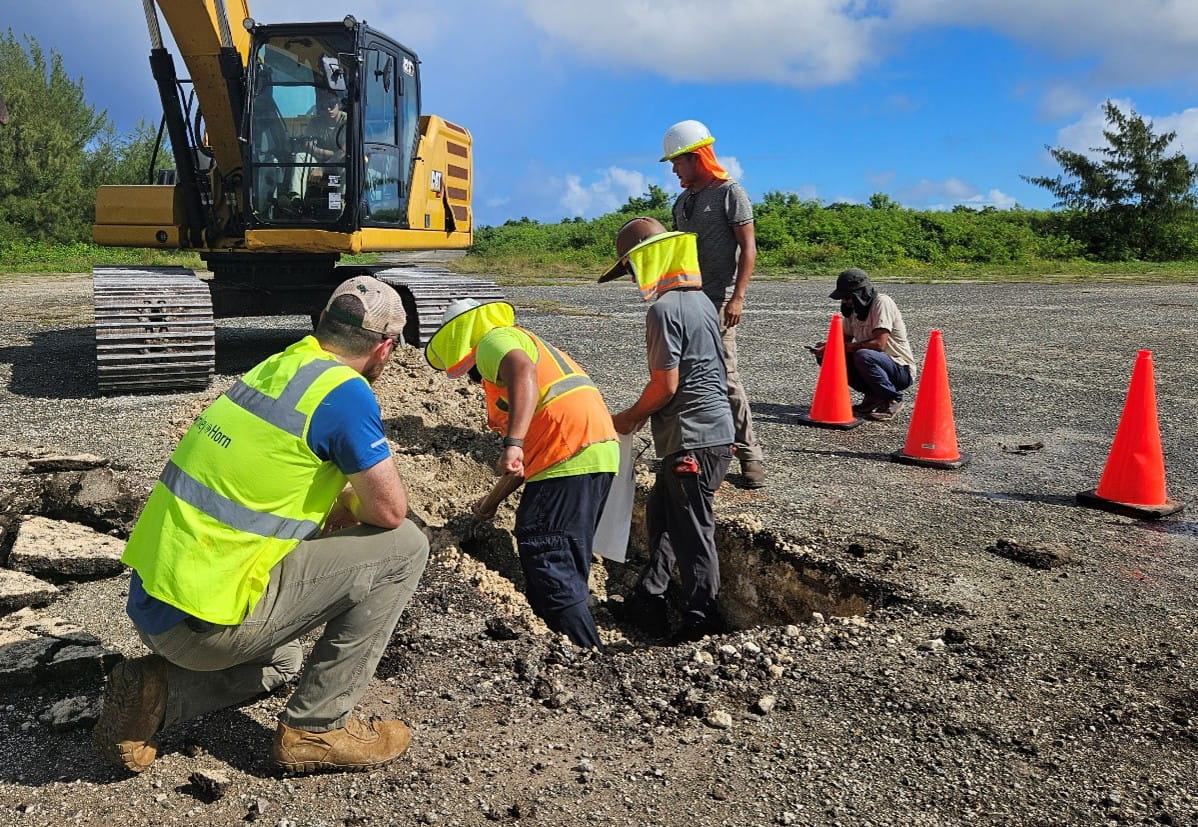
At Tinian North Field, geotechnical and geophysical data were used to tailor pavement designs to mission requirements, maximize reuse of local materials, and develop constructability heat maps that provided military engineers visibility into subsurface conditions before excavation. That precision supported engineering decisions that saved the government more than $100 million.
In both cases, better information enabled more precise decisions.
Why is precision important?
Every dollar spent on unnecessary reconstruction is a dollar unavailable for the next critical vulnerability. Risk-based pavement management replaces the traditional “sledgehammer” approach with a more surgical one.
Major rehabilitation is reserved for locations where the pavement system truly requires it. Other areas remain in service through targeted maintenance, active monitoring, and strategically timed repairs.
Airport pavements are among the most valuable and mission-critical assets on an airfield. Managing them effectively requires more than condition ratings alone. With advances in geospatial mapping, structural evaluation, geophysics, digital modeling, and data visualization, airports can now make decisions with a level of confidence that was previously impossible.
What’s next for pavement management?
The future of pavement management is not bigger budgets. It is better decisions.
By understanding risk at every depth, from the surface to the subgrade, airport owners can direct limited resources where they produce the greatest improvement in safety, resilience, mission readiness, and long-term value.


Related Insights