DSRC and C-V2X: Revisiting the Future of Connected Vehicles After the FCC NPRM
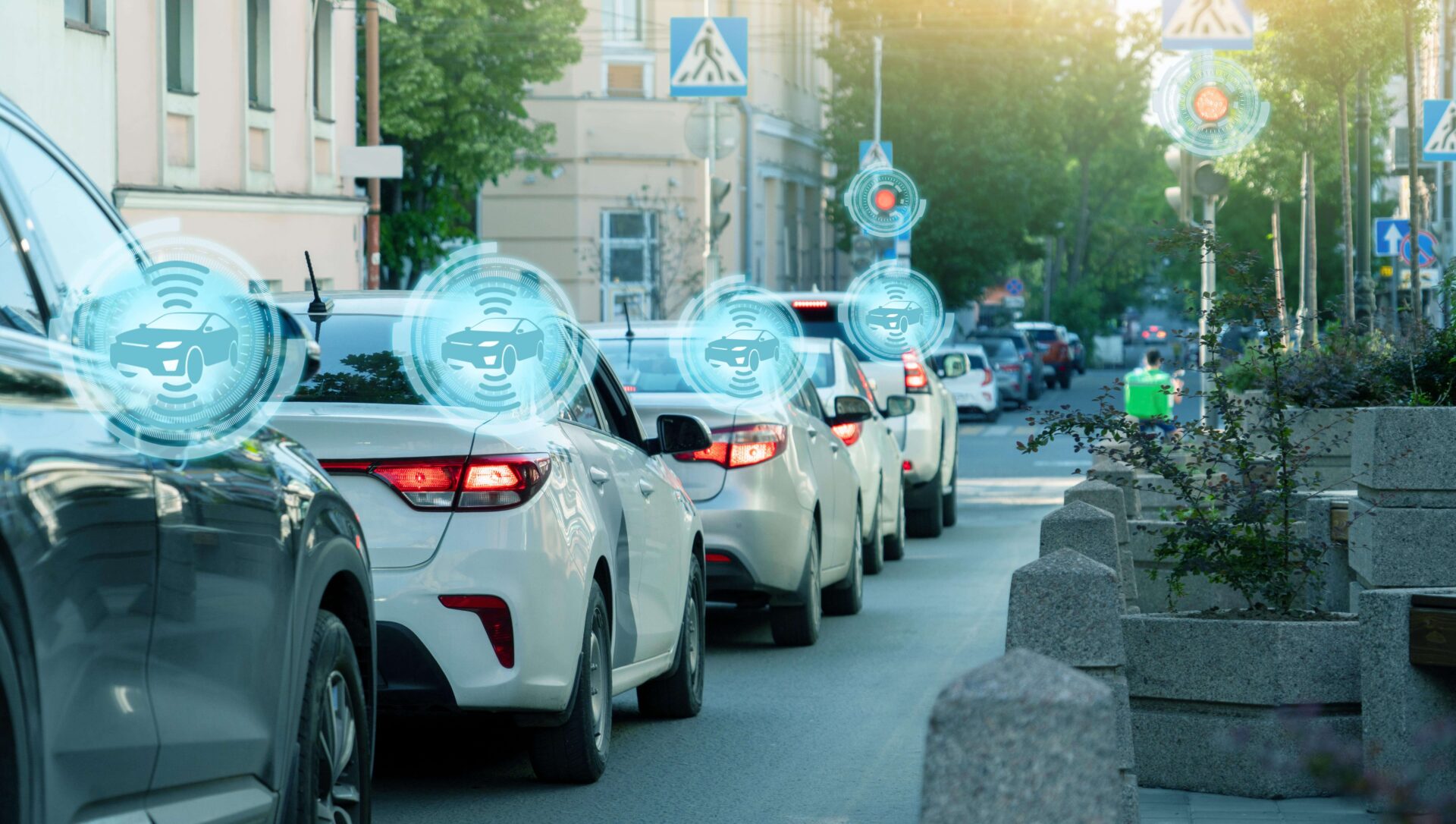
Last year, we navigated the differences between DSRC and C-V2X. Then, in December 2020, the FCC announced its plan to reallocate some of the spectrum assigned for DSRC to Wi-Fi services. At the same time, the FCC sided on behalf of C-V2X, rather than DSRC, as the new radio technology standard for connected vehicles. Read on to learn what this means and what the future holds for connected vehicles.
The FCC’s 5.9GHz Spectrum Decision
The FCC acknowledges throughout its Notice of Proposed Rulemaking (NPRM) that traffic safety is important. This decision to remove 40Mhz of 5.9GHz for ITS safety (and at the same time, favor C-V2X over DSRC for the remaining 30Mhz) is not about trading safety for economic gain for Wi-Fi suppliers, nor quality of service for Wi-Fi users. What is asserted is that connected vehicle technology using DSRC has simply not been fast enough to become a reality. In many ways, this is the natural evolution of technology. We’ve seen it before in the evolution from 8-tracks to cassettes to CDs to portable media players, and now to digital streaming. You could make the analogy that advocates for DSRC want to continue using cassette players when CD players are available.
But that analogy is flawed. There is no current large-scale safety benefit of 5.9GHz because there is no appreciable amount of users (not many people have cassette players). So, to the FCC, if it may still be 15 years before the spectrum is used to its full potential (every car has a cassette player), there are other uses, including network offloading, that immediately provide societal benefits. While those benefits are economic, they’re massive and useful as we become increasingly reliant on Wi-Fi, and particularly given the stresses that Wireless Internet Service Providers (WISPs) endured over the past year as so many people were working from home.
DSRC Is Out
If DSRC were being used by 10,000,000 vehicles in the spectrum today, the FCC argument that the lower 40 Mhz of 5.9hz should be allocated to unlicensed Wi-Fi would be made significantly weaker. However, the reality is that fewer than 50,000 vehicles in the U.S. have DSRC (or C-V2X, for that matter) and that is being generous. That is roughly one vehicle in every 6,000 on the road today. Think about how many vehicles you might see on your daily commute or typical trip. If you had DSRC, you probably wouldn’t encounter another vehicle with a radio at all, or maybe one or two. The major demonstration programs that have 5,000 and even 10,000 or more equipped vehicles are still surrounded by 50x to 100x or more vehicles that aren’t equipped. Yes, it’s true that many of those vehicles have been equipped with the intentional knowledge that they’ll be roaming frequently around the same general area (downtown NYC, I-80 in Wyoming, etc.), so they will have interactions with each other, and with roadside equipment. But those test fleets are still engulfed by traffic that is not equipped.
The Future of 5.9Ghz Spectrum Technology
ITS America and the other advocates for the protection of the lower 40 Mhz of the 5.9Ghz spectrum are focused on the future of this technology to improve traffic safety, and that future is still a ways away because NHTSA has not mandated that Original Equipment Manufacturers (OEMs) install some kind of 5.9 radio, and only about 7% of the vehicle fleet is replaced every year. Using basic math, if all OEMs started installing on-board units (OBUs) today, it would still take approximately 14 years to have the majority of vehicles equipped with a radio. And while plenty of advocates promoted that manufacturers should have installed the radios without a NHTSA mandate, this is not just about choice in technology—like choosing whether you want CDs, cassettes, or even vinyl records—it’s about interoperability and compatibility. Without standardization, we would be in an even worse situation. Standardization gives the industry focus and assurance that their design, manufacturing, and marketing efforts will not be in vain. Further, it would encourage the after-market product manufacturers to embrace the standard, which would allow non-equipped vehicles to take advantage of the technology more readily before fleet turnover.
As discussed in the previous comparison of DSRC and C-V2X, there are many benefits from just 10-15% of the fleet being outfitted, but that still takes two to three years to achieve assuming OEMs are required to do it, and maybe double that or longer if they are not required by NHTSA to do it.
Let’s look at what the FCC decision means by removing some of the allocation of 5.9Ghz for V2V and V2I safety, assuming we move forward with C-V2X and dropping the advocacy for cassette players (that don’t have much of a user base) when CDs have just been released.

What the 5.9GHz Spectrum Reduction Means
The goal of this article is not to give everyone a crash course in radio engineering. Much of the literature related to this topic is jargon-dense, academic, or both. Valuable? Absolutely. Understandable? Sometimes not so much. The goal is also not to go into detail regarding bad actor interference, cross-channel interference, band gaps, antenna power, the effect of varying types of channel encoding, and the other technical stuff that leaks its way into this conversation and can create confusion on what is most important.
Here’s the basic idea: seven channels are currently allocated to DSRC, each with 10MHz of spectrum. Each channel has been allocated to a specific purpose. Just like a traditional radio, tuning to another channel delivers a different kind of music, news, or sports chatter. The FCC is planning to take away four, leaving three. Let’s see what that means.
The primary message of a connected vehicle is the basic safety message (BSM). The BSM is simply the location, heading, and speed of the vehicle, augmented with some other vehicular/situational data like wiper blades on/off, airbag deployed, or anti-lock braking system engaged. BSMs are all supposed to be exchanged in the same channel. Everyone is listening to the same music, otherwise I’m listening to Beethoven (some subset of BSMs from vehicles around me) and you are listening to Nirvana (a different subset of BSMs from vehicles around me) and we crash into each other.
Each of these messages is about 300 bytes. If you open the file explorer on your computer and look at the size of a file, it is usually listed in kilobytes (KB). Microsoft Windows considers this amount of data so trivial that they don’t list anything less than 1KB, but this is the equivalent of 300 bytes in text:
The equivalent of that much text in a BSM is the latitude, longitude, altitude, speed, acceleration, and some other security and privacy information. This is broadcast by each vehicle 10 times per second (100 milliseconds). In computer terms, this is not a lot of data. One frame (1/30th of second) of a compressed HD video is more than 100 times larger. The data rate at 5.9GHz is around 6Mbps (6 million bits per second). So, if you divide one second by 10, you can transmit 600,000 bits per 100 millisecond chunk. If all messages are 3,000 bits (i.e. 300 bytes x 10 bits/byte), there are around 200 separate slices of each 100 millisecond chunk to go around (600,000 bits / 3,000 bits).
Breaking Down BSMs
If you’re wondering why this this important, this means that a DSRC channel gets saturated when 200 vehicles are trying to simultaneously talk to one another by broadcasting BSMs ten times per second. Let’s look at the limiting case. Say you’re on a four-lane freeway at rush hour and you’re in a traffic jam with all lanes full in both directions. If there is a vehicle every 10m or so, you’ve got around 400 vehicles within radio range, which is roughly about 500m. If 50% of those vehicles have C-V2X radios, no one can hear anyone’s BSMs anymore because the channel is saturated. Now with everyone, or most everyone, going very slowly, does it matter if no one can hear BSMs? What if an emergency vehicle comes speeding down the shoulder to get to a downstream crash? Would you want to hear those BSMs? Of course!
The bad news is, unfortunately, even before that, more and more of the messages get progressively lost because there are so many vehicles talking at the same time. Think about when you are trying to use Wi-Fi or your cellular service at a conference or a sporting event. People that are also customers of your cellular carrier are using the same cell tower at the same time. Everyone’s calls don’t just stop working completely; you get bad quality audio and a whole lot of delay, and then finally you can’t get your Instagram to load at all. The thing is, C-V2X messages can’t tolerate delay for active safety applications. If you don’t get your text message in a few seconds, so what? If your vehicle doesn’t get the message that says the vehicle ahead of you is braking and braking hard, the results are more detrimental.
Since the information is broadcasting out to everyone around (remember, it’s like tweeting, not DMing), your radio is able to listen to all vehicles talking simultaneously.
Now that’s one channel (10MHz). If you provide the whole 30Mhz as just one channel instead of three, you don’t get exactly 3x the capacity, because some of the other message types are bigger than the BSMs. For example, signal phase and time (SPaT), MAP, and service announcements are 10-50 times bigger. Let’s say our channel capacity for 30Mhz is only double that of 10Mhz for BSMs. Now the channel is saturated only when 100% of the vehicles have C-V2X radios in our traffic jam example. That certainly extends the lifetime of C-V2X for a couple more years.
Admittedly, this explanation skips some other technical considerations, but at the end of the day, we’re worrying about limitation of the channel capacity that won’t emerge for many years, and even then, the case where channel saturation is really a critical failure is a rare occurrence. Yes, there are some near-term impacts to the way that existing standards work (for one, BSMs are already being transmitted on a channel that’s being removed) and existing investment by public agencies in DSRC is probably lost, but really, we need to just move ahead with C-V2X in the 30Mhz and save some lives.
What’s to Come for C-V2X
The 5G Automotive Association (5GAA) is already planning for provisions in the next generation of C-V2X to better handle situations where channel saturation is at risk. For example, you don’t really need to hear vehicles that are 500m away from you when you are going 10 mph in a traffic jam. Yes, if on a two-lane road and a vehicle without their headlights on has crossed the center line, your vehicle needs to know that (whether or not it has its own sensors or can drive itself). But in a traffic jam, all those extra BSMs from 500m away are just noise. Things like vehicle area networks (VANETs) and multicasting should address some of the channel saturation problem by only listening to the vehicles that are closest to you. Even ITS America’s recent analysis of the channel saturation situation quietly stepped down the BSM transmission rate from 10 times a second to five times a second. A simple de-throttling of BSM rates when vehicle speed is low (or when stopped at a red light going zero) will go a long way. In the same way, doubling the data rate from 6Mbps to 12Mbps has the same effect.
The Impact of Autonomous Vehicles
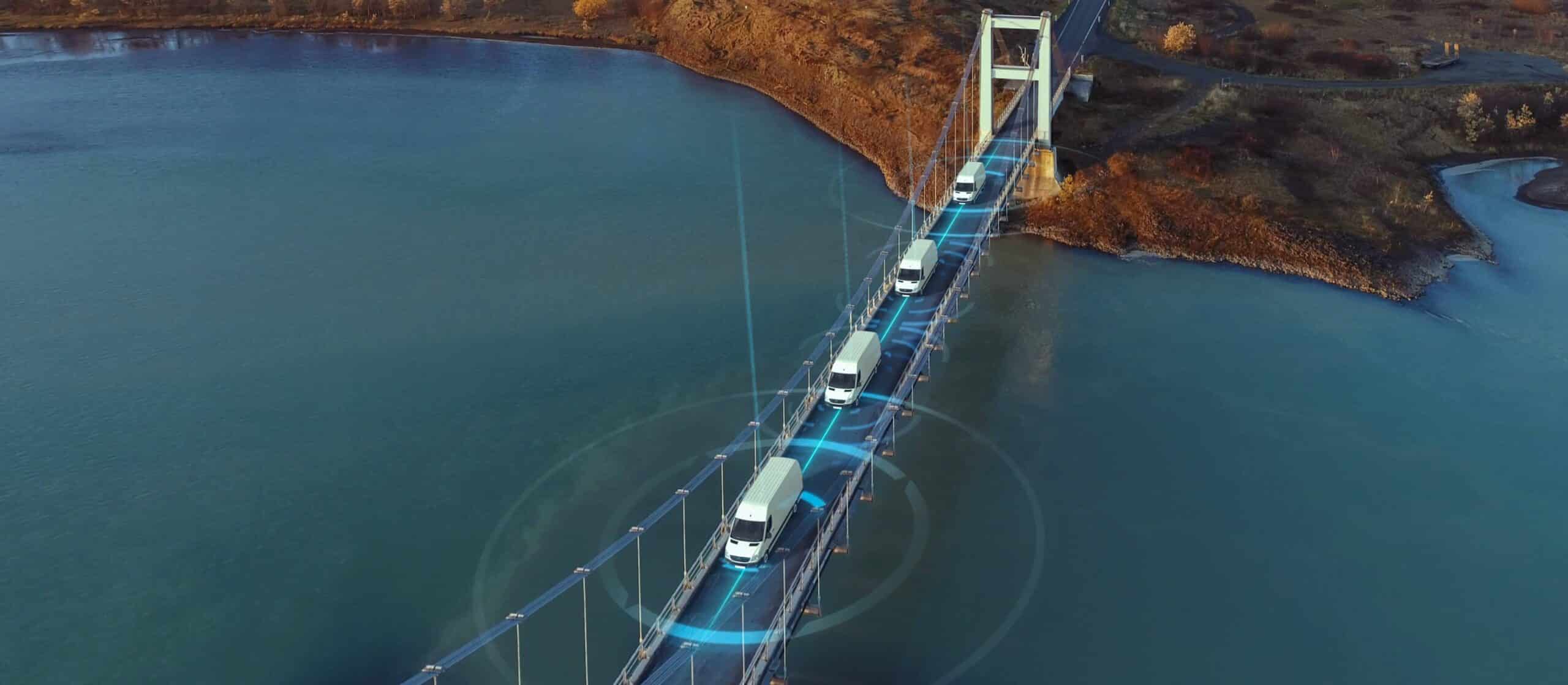
Should we bother with this at all? Aren’t automated vehicles going to solve this anyway? Well, maybe. First off, any additional information provided to an autonomous vehicle (AV) can only help the situational awareness of the AI. Cameras and LiDAR have occlusion issues, which is why the LiDAR of most AVs is sitting on the roof. Vehicles like school buses are probably not first in line to become fully automated. Not everyone is fully on board with robot cars. C-V2X and AV are complementary, not competing. And we barely have AVs today, much less AVs that need to talk to each other.
The Bottom Line
In most situations, for a significant number of years, channel saturation with 30Mhz of 5.9Ghz is not going to be a problem. By any simple calculus, 50% of vehicles in the US having C-V2X radios is at least seven years away. Close to 100% is probably twice that time. 6G is already projected to be readily available by 2030 with even more capability for the point-to-point communications we need for V2X safety using C-V2X, in communications bands much more capable than 5.9GhZ. The FCC will probably allow ITS communication to co-exist in unlicensed bands (see pages 76 and 77 of the FCC register), or new spectrum if we can collectively decide where that should be. Should we just wait until then? No. Let’s move forward with C-V2X in our 30Mhz and save some lives.

Related Insights