SB 261 – Climate-Related Financial Risk Disclosures
Reporting Framework
For this initial submission, in compliance with California SB 261 (which required reporting on or before 1/1/26), Kimley-Horn has chosen to report in conformance with the Final Report of Recommendations of the Task Force on Climate-related Financial Disclosure (TCFD) (June 2017). In alignment with the TCFD Final Report of Recommendations and the California Air Resources Board’s (CARB) checklist, this report includes disclosures within the categories of Governance, Strategy, Risk Management, and Metrics. For each, we have complied with CARB’s checklist and the TCFD guidance section titled, “Guidance for All Sectors” found in the 2017 Final Report of Recommendations of the TCFD. Kimley-Horn’s fiscal year is based on the calendar. Thus, this report aligns with the end of our 2025 fiscal year. CARB’s checklist permits companies in scope for SB 261 to exclude emissions reporting from their submission, due on January 1, 2026. Kimley-Horn will report on our 2025 emissions in compliance with SB 253 in 2026, and we anticipate including emissions reporting in all future SB 261 disclosures, but we have opted to exclude emissions reporting for 2025 from this disclosure.
Governance
Describe the Boards oversight of climate-related risks and opportunities.
Kimley-Horn’s Board of Directors (BOD), in coordination with the Company Leadership Team (CLT), maintains oversight of the firm’s enterprise risk management framework and business continuity plans, which collectively form the foundation for identifying, assessing, and managing climate-related risks and opportunities. These considerations are integrated into strategic planning and risk analysis processes and are discussed at the BOD and CLT levels.
In 2023, the CLT established the position of Director of Resiliency and Sustainability to lead the firm’s initiatives related to climate risk and opportunities. This role is responsible for advancing the firm’s capabilities in climate adaptation (resiliency) and climate mitigation, enhancing Kimley-Horn’s service offerings to clients in consulting and design.
Additionally, the CLT allocates annual resources across key operational areas including financial controls, operations, real estate, information technology (IT), practice or production management, and marketing to support internal risk reduction efforts, climate-related disclosures and reporting, and the expansion of services that assist current and future clients in addressing climate adaptation and mitigation challenges.
Describe Management’s role in assessing and managing climate-related risks and opportunities.
Kimley-Horn’s management structure—including the Board of Directors (BOD), Company Leadership Team (CLT), Regional Leader Team (RLT), Operations Teams (OT), and Practice Advisory Committee (PAC)—collectively oversees the identification, assessment, and integration of climate-related risks and opportunities into business operations and strategic planning.
The BOD and CLT, through an established Sustainability Task Force, lead firmwide efforts to manage climate risks and pursue growth in climate adaptation and mitigation services. The RLT appoints Regional Sustainability Champions (18 designated in 2025) to support office-level sustainability initiatives and promote best practices in environmental stewardship within regions and individual offices.
The OT implements operational measures to reduce climate-related risks, including sustainable office design (e.g., LEED standards, water efficient appliances, etc.), elimination of PFAS in supplies, and enhancements in cybersecurity and energy and IT efficiency.
The PAC provides strategic guidance to practice leaders delivering climate-focused consulting and design services. Kimley-Horn’s commitment to sustainability is reflected in our #8 ranking on Engineering News-Record’s (ENR) 2025 U.S. Green Design Firms list.
Strategy
Describe the climate-related risks and opportunities the organization has identified over the short, medium, and long term.
For this disclosure, Kimley-Horn evaluated climate-related risks and opportunities across short-, medium-, and long-term horizons, generally defined as within one year, one to seven years, and seven to 25 years (through 2050), respectively. These time frames align with the nature of our business and our financial planning, which is based on the typical duration of our engagements and the relatively insignificant amount we have invested in fixed assets. We assessed our climate-related risks and opportunities using internal expertise and publicly available information for this disclosure, but we will continue to evolve and improve our processes as we learn from each assessment.
Risks
The following are a few of the specific physical climate-related risks that we included in our qualitative assessment, including a brief description of their impacts.
| Risk Type | Acute/Chronic | Time Horizon(s) | Impact |
| Storm/Cyclone | Acute | Short | Storms and cyclones cause hail, high winds, and heavy rainfall that can damage infrastructure and disrupt operations. They often lead to project or client disruptions, emergency repairs, and increased insurance and design costs for storm resilience for our client base. |
| Drought and Water Stress | Acute & Chronic | All | Drought and water stress cause prolonged dry periods and limited water availability, which can affect construction feasibility and resource planning. It may increase costs for water-dependent projects and create regulatory challenges in water-stressed regions. |
| Wildfires | Acute & Chronic | All | Wildfires bring smoke, extreme heat, and direct fire damage that threaten employee safety and physical assets. They can cause project delays, raise insurance premiums, and increase compliance costs for fire-resistant designs for our end user clients. |
| Flooding | Acute & Chronic | All | Flooding includes flash floods and river overflow that can damage facilities and halt projects. It often requires higher design standards, redesigns for flood resilience, and increases liability and maintenance costs for existing infrastructure and end users (i.e. our clients). |
| Sea Level Rise | Chronic | Long | Rising sea levels cause coastal erosion and saltwater intrusion, which threaten the long-term viability of coastal projects. It necessitates adaptation strategies, changes to design and construction costs, and potential relocation of assets. |
| Extreme Temperatures | Chronic | Long | Extreme heatwaves and cold snaps can reduce workforce productivity and damage construction equipment. They also increase energy demands and require design changes for resilience in both construction and operations and client projects. |
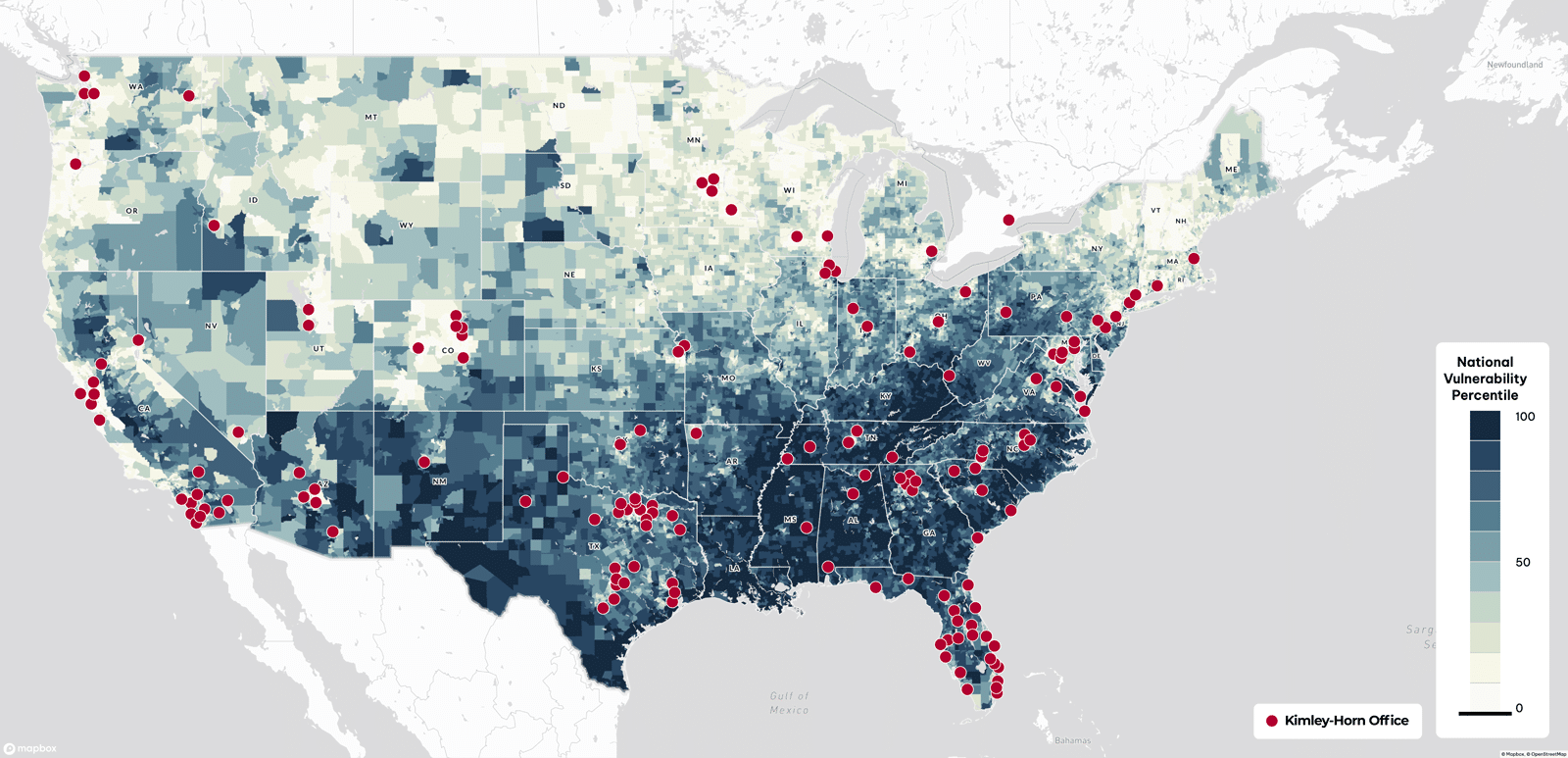 Overall Climate Vulnerability Map Layer provided by The U.S. Climate Vulnerability Index
Based on our assessment, Kimley-Horn’s risks are primarily associated with potential disruptions to personnel and data and technology assets or to the firm’s client base, which is approximately evenly split between private and public sector entities. These clients are extremely diverse. Over 10,000 clients across all 50 states are serviced by our firm and include cities, agencies, districts, utilities, states, federal agencies, landowners, developers, retailers, technology companies, and many others. Our largest client represents less than 5% of our business. Our offices and employees are broadly distributed – no single Kimley-Horn office is home to more than 5% of our employees – creating the ability for our operations to remain resilient even with an acute local issue that might effect one portion of our operations. Over the long-term, widespread economic disruptions caused by any of these risks may materially impact our ability to sell and perform work. For example, long-term wildfire risks are material to our California and Mountain Pacific regions in the short- and long-term. Drought and water stress is also a long-term material concern for our California and Southwest regions. These risks may impact the types and quantities of services we are able to sell in these regions over the long-term and may also impact where we site offices and employees.
Opportunities
Kimley-Horn’s assessment of climate-related transition risks revealed primarily significant opportunities, as we are well-positioned to partner with public and private entities driving the transition to a low-carbon economy that are supported by more resilient infrastructure and development. We have identified material climate-related opportunities across the short-, medium-, and long-term, primarily through our role as a professional consulting and design firm supporting the transition of energy, land use, water, transportation, and infrastructure systems toward greater resilience and sustainability. One recent example is our work with the Transportation Agency of Monterey County (TAMC) to develop a climate adaptation and resiliency strategy for an 8-mile stretch of Highway 1 (PCH), addressing flooding, sea-level rise, ecosystem protection, and storm surge risks.
Opportunities include planning and design services for new development, redevelopment, and infrastructure upgrades across commercial, industrial, residential, energy, power, and public infrastructure sectors. Climate change has increased demand for services related to damage assessments, recovery, risk mitigation, climate adaptation plans, and future-proofing of assets and infrastructure.
As a professional services firm, Kimley-Horn’s principal assets are our personnel, data, and technology systems. These are supported by flexible work environments, including over 150 leased offices, remote work capabilities, and secure cloud data infrastructure.
Overall, as a design and consulting firm focused on development and infrastructure, we see opportunities that far outweigh the risks for the short-, medium-, and long-term as we support the transition of developments and infrastructure to mitigate and adapt to climate risks.
Describe the impact of climate-related risks and opportunities on the organization’s businesses, strategy, and financial planning.
As climate-related opportunities have emerged, Kimley-Horn has worked proactively to integrate these into our business strategy to drive sustainable profitability. For example, Kimley-Horn invests in Diversification Focus Areas (DFAs) targeting growth markets such as renewable energy, zero-emission infrastructure, ports, water, data centers/infrastructure, sustainability, and resiliency. These investments have driven measurable business expansion in recent years. Based on the success of these investments and the trajectory of the economy towards being more sustainable, Kimley-Horn will continue to invest in DFAs and prioritize them in our long-term strategy.
To date, Kimley-Horn has successfully mitigated or avoided any material impacts from climate-related risks on our operations and financial performance. Our short-, medium-, and long-term business strategies all account for our exposure to future climate-related risks. The benefits we recognize from proactively adapting to worsening climate change have reinforced our long-term strategy and financial planning, including our focus on continuing as a single profit center, building flexibility into our staffing plans, and prioritizing disbursed, smaller offices located near metro areas.
Describe the resilience of the organization’s strategy, taking into consideration different climate-related scenarios, including a 2°C or lower scenario.
Kimley-Horn’s strategy is designed to remain resilient under varying climate-related scenarios, including a 2°C or lower scenario. Our annual business planning process, combined with mid- and long-term strategic visioning, provides flexibility to adapt to evolving operational and market conditions. This approach enables timely adjustments to address regulatory changes, market shifts, and environmental factors.
As a 100% employee-owned design and consulting firm with a diversified portfolio of services and small, local offices nationwide, Kimley-Horn’s operations and strategy are significantly resilient to climate-related risks. While our employees work in offices across the country, Kimley-Horn functions as a single profit center, which means the performance of no single office is prioritized over another, and resources can easily shift to where there is the highest need. This flexibility is an invaluable climate resiliency tool, as our employees can seamlessly move across geographical locations without financial or contractual barriers and without any disruption to our client service. We manage this flexibility through a forecasting tool called Castaheads. This tool allows Leadership to see where capacity exists and deploy resources to maintain project timelines over the short- (one month), medium- (3-6 month), and long-term (6+ months), especially during local disruptions. Relatedly, our business strategy prioritizes small offices located near metro areas, which boosts our client relationships but also helps build resilience to climate-related risks. Impacts to any one office are not as significant to Kimley-Horn overall. Business plans, sector strategies, and continuity plans are reviewed and updated at least annually, ensuring responsiveness to changing climate scenarios. Investments in DFAs and ongoing market research further strengthen the firm’s ability to manage risks and capitalize on opportunities under both moderate and severe climate pathways.
Risk Management
Describe the organization’s processes for identifying and assessing climate-related risks.
Kimley-Horn’s management structure—including the Board of Directors (BOD), Company Leadership Team (CLT), Regional Leader Team (RLT), Operations Teams (OT), and Practice Advisory Committee (PAC), collectively oversees the identification, assessment, and integration of climate-related risks and opportunities into business operations and strategic planning.
For this disclosure, we relied on internal expertise and publicly available information in identifying and assessing climate-related risks. The Director of Resiliency and Sustainability formed a working group with members of the BOD and other relevant experts across the company. Risks were discussed and assessed qualitatively using historical knowledge of impacts on the company and publicly available information. We routinely evaluate our processes for identifying and assessing climate-related risks, and this disclosure will be incorporated into that ongoing evaluation.
Describe the organization’s processes for managing climate-related risks.
Kimley-Horn integrates climate-related risks and opportunities into our annual market-based business planning process, which informs revenue forecasts, expense planning, and financial goals. Short-term impacts are reflected in market research used to anticipate client demand and in operational planning to safeguard key assets, including personnel, data, and technology systems, while accounting for regulatory requirements.
Medium-term impacts and market opportunities are addressed through sector-specific strategies developed by practice leaders and reviewed annually by firmwide leadership to refine the 3- to 7-year strategic vision.
This integrated planning approach enables the firm to proactively manage climate-related risks and leverage opportunities to support both short- and long-term business stability and growth.
Describe how processes for identifying, assessing, and managing climate-related risks are integrated into the organization’s overall risk management.
As stated previously, the CLT maintains oversight of the firm’s enterprise risk management framework and business continuity plans which collectively form the foundation for identifying, assessing, and managing climate-related risks and opportunities. Consistent collaboration between the BOD, CLT, RLT, OT, PAC, and the Director of Resiliency and Sustainability at Kimley-Horn drives the identification, assessment, and management of climate-related risks and opportunities. Through collaborative effort and constant communication, we proactively integrate climate-related risks opportunities into our business strategy and financial planning. We regularly evaluate our risk management framework, including our management of climate-related risks, and we will integrate what we have learned from this disclosure into that ongoing evaluation.
Metrics
Disclose the metrics used by the organization to assess climate-related risks and opportunities in line with its strategy and risk management process.
The table below lists our primary data sources for assessing climate-related risks and opportunities.
| Category | Metric, Data, or Process | Source |
| External Climate Data | NOAA climate projections (temperature, storms, etc.) | NOAA |
| External Climate Data | IPCC scenarios (including 2°C pathway) | IPCC |
| External Wildfire Data | Wildfire Risk to Communities | USDA Forest Service |
| External Water Stress Data | Aqueduct – Global Water Risk Indicators | World Resources Institute |
| External Rankings | Green Firm Ranking | Engineering News-Record (ENR) |
| Market Opportunity
(Short-Term) |
% revenue from climate-related services | Annual Business Plan |
| Mid-Term (5-7 years) Opportunities | Annual DFA investment in climate markets + Annual Practice Meetings | Marketing, Annual Business Plan, and DFA annual reports |
| Operational Resilience | Business Continuity Plan updates (3-4/year) | FW Communication
Crisis Response Team |
| Real Estate Resiliency (Leased Space) | LEED Standard Build Outs | Internal Ops/Real Estate |
| Human Capital | # Sustainability roles (Director, Regional Champions, etc.) | HR |
| IT/Data Resilience | Cybersecurity compliance (CMMC Level 2) | IT |
| IT | Energy efficiency improvements and Cloud Data Security and redundancy | IT |
Disclose Scope 1, Scope 2, and, if appropriate, Scope 3 greenhouse gas (GHG) emissions, and the related risks.
We calculate our GHG emissions annually and include the calculations in our annual Responsibility Report. As of the date of this filing, we are continuing to finalize our 2025 GHG emissions calculations. Kimley-Horn is in scope for SB 253 and will be prepared to disclose our emissions in compliance with the statute.
For reference, please find Kimley-Horn’s 2024 Scope 1 and 2 emissions in our 2024 Responsibility Report.